


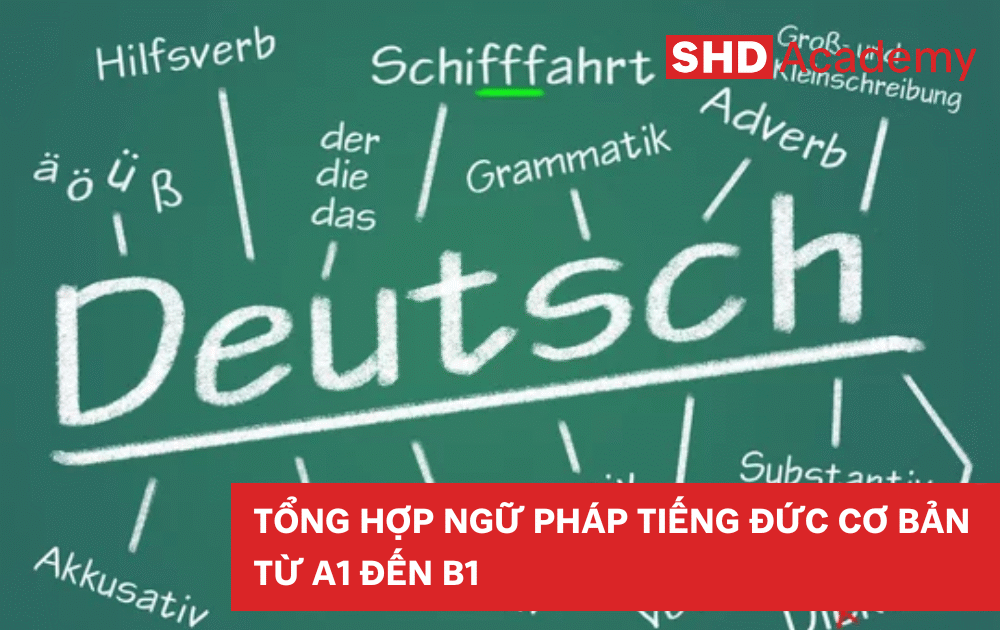
Summary of basic German grammar from A1 to B1
- 13/06/2025
- Hong Hanh
- News study abroad in Germany
- No Comments
When starting your journey to study a profession in Germany, it is important to master German grammar is a prerequisite for you to be able to study and work effectively. Whether you are at level A1, A2 or B1, understanding grammar rules will help you confidently communicate, read and understand specialized documents and pass compulsory language exams such as TELC or Goethe. Through the article below, SHD Academy will help you systematize grammar knowledge from basic to advanced, and at the same time provide tips for learning German effectively.
>> Reference:
- Guide to effective German learning path from A1 to B1
- German language certificates you need to know when studying vocational training in Germany
- Basic German vocabulary and sentence patterns for beginners
General characteristics of German grammar
German grammar is famous for its tight structure and clear rules. To use it effectively, you need to understand the basic structure right from the start:
1. Word order
In German, the main verb in an affirmative sentence is always in position 2. In a subordinate clause, the verb is pushed to the end of the sentence. For example:
- Wir lernen Deutsch (We learn German).
- Ich denke, dass sie heute kommt (I think she will come today).
2. Same word
German nouns are divided into three genders: masculine (der), feminine (die) and neuter (das). Memorizing gender is an important foundation for using articles and conjugation correctly. For example:
- der Stuhl – the chair (in which “Stuhl” is a masculine noun so the accompanying article is “der”)
- die Uhr – the clock (in which “Uhr” is a feminine noun so the accompanying article is “die”)
- das Buch – the book (in which “Buch” is a neuter noun so the accompanying article is “das”)
3. How to conjugate verbs
Verbs in German are conjugated according to person (ich, du, er…) and tense (present, past, future). Examples with verbs lernen (learn):
- Ich lerne Deutsch – I study German.
- Travel lernst sehr schnell – You learn very quickly.
- Er learn jeden Tag – He studies every day.
4. Cases
German uses four ways to indicate the role of a noun in a sentence:
- Nominativ – Subject (person or thing performing the action)
- Akkusativ – Direct object (person or thing affected by the action)
- Dativ – Indirect object (receiver of action or thing)
- Genitiv – Possessive (expresses ownership or belonging).
For example: Die Frau zeigt dem Lehrer einen Brief. In which, “die Frau” is the subject, “dem Lehrer” is the indirect object, “einen Brief” is the direct object.
>> Reference:
- German alphabet and standard pronunciation for beginners
- What are the conditions for vocational study in Germany in 2025?
Detailed German grammar for each level
German grammar is divided into levels from A1 to C2. Of which, the three levels A1, A2 and B1 are important foundations for beginners and those preparing to study vocational training in Germany. Learning grammar at each level helps you build knowledge from basic to advanced in a systematic, easy-to-understand and easy-to-apply way.
German Grammar A1
In the beginner stage, you just need to grasp the grammar to introduce yourself, communicate in basic daily life and ask simple questions.
| Main points | Describe |
| Article | Use the definite articles der, die, das correctly according to the gender of the noun (masculine, feminine, neuter) and the indefinite articles ein, eine for non-specific nouns. |
| Noun | Nouns are always capitalized. Be sure to distinguish between singular and plural, remember masculine/feminine/neuter genders, and recognize common noun endings. |
| Present tense (Präsens) | Verbs are conjugated according to person (ich, du, er/sie/es…) and are common verbs. Basic structure: Subject + Verb (conjugated according to person). |
| Declarative sentence (Aussagesatz) | Simple sentences follow the order Subject – Verb – Object (S–V–O). If there is an adverb (time, place), the verb is still in position 2. |
| Question (Fragesatz) | Understand questions with interrogative words: starting with wo, wie, was, wann… and closed questions (ja/nein): starting with verbs. |
German Grammar A2
After mastering A1 grammar, learners move on to A2 level – the stage of consolidating and expanding knowledge. A2 grammar requires you to flexibly use subordinate clauses, negative sentences and past tenses.
| Content | Describe |
| Negation | Distinguish and use correctly between nicht (negation of verbs, adjectives, adverbs, or entire sentences) and kein (negation of indefinite nouns). |
| Prepositions (Präpositionen) | Learn prepositions with Akkusativ (für, durch, gegen…) and Dativ (mit, bei, seit, nach…). Master the conjugation form that goes with each type of preposition. |
| Past tense (Vergangenheit) | Use two basic tenses to recount past events: Perfekt (usually used in speech) and Präteritum (usually used in writing). Know how to conjugate regular and irregular verbs. |
| Relative clauses | Use the relative pronouns der, die, das to connect two clauses and replace repeated nouns. It is important to understand the gender and case (Nominativ, Akkusativ, Dativ) of the noun being replaced. |
German Grammar B1
B1 is the first intermediate level and is also the minimum requirement for many vocational study abroad programs in Germany. At this level, you need to master more complex sentence structures such as conditional sentences, passive sentences and subordinate clause systems. This is a stepping stone for you to be more confident in interviews, writing resumes and communicating in a professional learning environment.
| Main points | Describe |
| Conditional sentences (Konditionalsatz) | Use wenn…würde, hätte/wäre + Partizip II to describe unreal conditions in the present or past.
For example: Wenn ich Zeit hätte, würde ich reisen. |
| Passive voice | Use the structure werden + Partizip II in tenses such as present (Präsens), past (Präteritum), perfect (Perfekt).
For example: Der Brief wird geschrieben. |
| Subordinate clauses (Nebensätze) | Including subordinate conjunctions such as weil (because), obwohl (although), dass (that), which affect the verb position – the main verb is at the end of the clause.
For example: Ich glaube, dass er krank ist. |
>> Reference: Is learning German difficult? How long does it take to achieve a certificate B1
Tips for learning German grammar effectively
Here are some German learning experience The results are compiled from students that you can refer to:
- Learning through real-life contexts: Watch movies, listen to podcasts, read German newspapers or stories to observe how native speakers use grammar naturally in everyday communication.
- Focus on sentence structure and gender: Prioritize memorizing the articles that go with nouns and practice conjugating verbs in the correct person.
- Using the support application: Study through platforms like Anki, Quizlet, Duolingo to review vocabulary and grammar structures in the form of flashcards or fun quizzes.
- Create mind maps and summary tables: Review grammar topics such as tenses (Präsens, Perfekt, Präteritum…), passive voice, conditional sentences… for easy remembering and comparison.
- Do exercises regularly: Practicing German grammar exercises A1, A2, B1 helps you practice your analytical skills and quick grammar thinking.
- Join a German class or group: Regular communication helps you practice reflexes and understand how to use sentence patterns in real life.
To receive systematic guidance and support throughout the process of conquering German, you should choose reputable centers such as SHD Education - a unit specializing in German training according to a scientific, easy-to-understand roadmap, suitable for each level from A1 to B1.
>> See more articles related to learning German:
- Top 10 effective websites to learn German online
- Effective German learning youtube channel for all levels
- TOP 10 classic and most worth-watching German movies of 2025
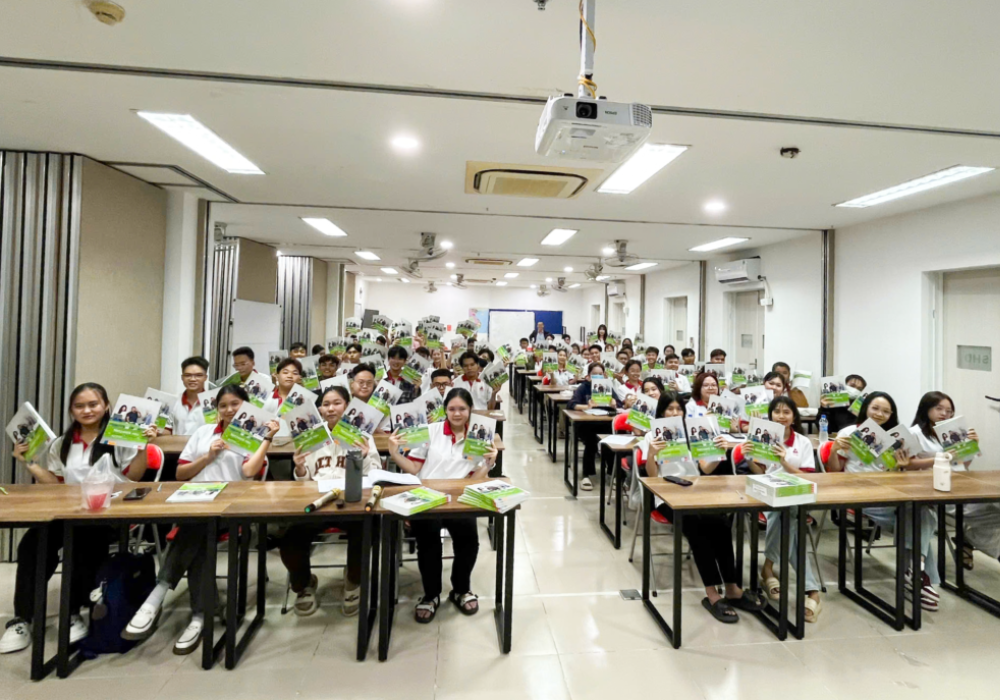
Conquer German with SHD Education
SHD Education is German language center Part of the SHD ecosystem - a pioneer in the field of vocational study abroad in Vietnam. With the motto "Study solidly - Use it", SHD Education not only teaches theory but also integrates communication skills, logical thinking and the ability to handle real-life situations in German. From there, students are not only confident in communication but also quickly adapt to the learning and working environment in Germany later. Specifically, below are the outstanding values that SHD Education brings:
- Lean and effective roadmap: Students are supported with free entrance tests, helping to determine a suitable learning path. With intensive and semi-intensive courses, students can achieve TELC B1 certificate in just 9 months, saving time while still ensuring quality.
- Netzwerk New international standard curriculum: The Netzwerk New curriculum offers a wide range of topics, from everyday life to professional fields, helping students easily approach and conquer the TELC certificate according to their personal goals.
- Personalized Learning: Focus on exploiting the needs and receptive abilities of each student, ensuring that each person has access to content appropriate to their level.
- Experienced teaching staff: Students interact directly with Vietnamese teachers and native teachers with more than 30 years of teaching experience, ensuring exam preparation and TELC certification according to the goals set by students.
>> See more:
- Which vocational training major in Germany should you choose for high salary in 2025?
- Total cost of vocational study in Germany latest 2025

Mastering German grammar not only helps you pass the certification exams but is also the key to studying, working and integrating effectively in Germany. If you are looking for a reputable German language training center that is suitable for your vocational study abroad path, SHD Education is the ideal choice. Contact us now Shd Education Call hotline (+84-28) 6276 0276 for detailed advice!


